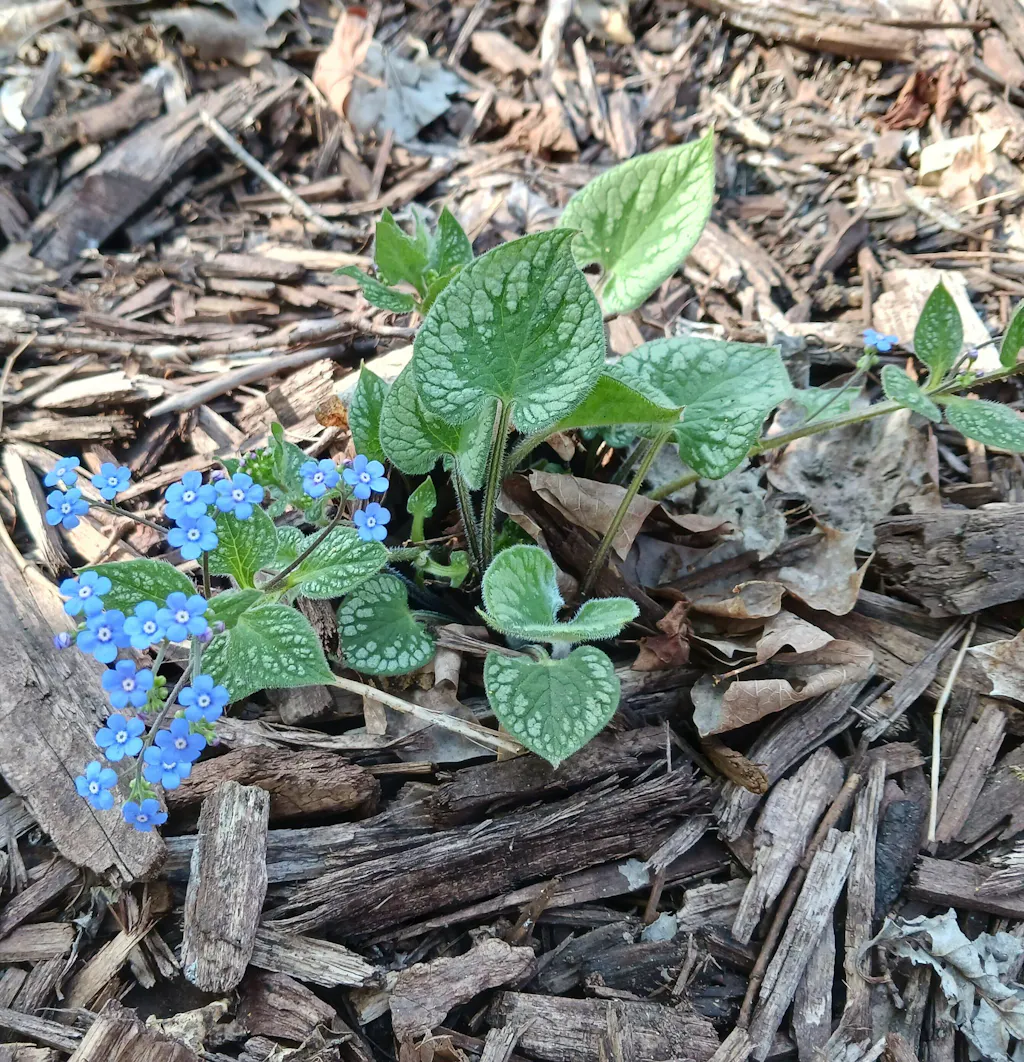
'Emerald Mist' Siberian Bugloss (Brunnera)
Perennial
- Deer & rabbit resistant flowering ground cover!
- Delicate blue flowers look great in containers.
- Silvery green foliage adds interest to shade gardens.
- Zones 3-8, part sun/shade, 15" tall x 15" wide at maturity.
 ZONE
ZONE
 EXPOSURE
 HEIGHT


Description
Siberian bugloss, or Brunnera, are reliable and hardy shade perennials with silver foliage. Sprays of forget-me-not-like flowers rise above its low-mounding foliage in spring, which can be enjoyed alongside lungworts, foamflowers, or other spring bloomers. Given that it's low maintenance, deer resistant, and tolerant of shade, it's effortless to grow for gardeners of any level. Create an eclectic woodland garden by pairing it with other shade foliage plants, or plant it in masses for an attractive ground cover. However you use it, you can't go wrong!
Details
Patent: pp#20460
Common name: Heartleaf brunnera
Zone: 3 - 8
Sun exposure: Shade (-4 hrs/day) to part shade (4-6 hrs/day)
Height x width: 12-15" X 12-15"
Flower color: Sky blue flowers
Foliage color: Green with silver collar
Bloom time: Spring
Features: Wet soils, rain gardens, proven winners, heat tolerant, ground covers, deer resistant, cold tolerant
Uses: Container gardening, edging, ground cover, mass planting, ornamental, small spaces, specimen, under planting, woodland
How to Grow
Light: Full to part shade - can tolerate six hours of indirect sun each day. Shade is necessary for healthy plants and abundant blooms. If exposed to more sun it will require moist soil or supplemental watering to keep foliage from burning.
Water: Moderate, prefers even moisture.
Spacing: Plant 2' apart.
Fertilizing: Grow in well-drained soil that is moderately fertile and humus-rich. Fertilizing at planting time or during the first growing season is not recommended. If soil is poor in quality a light scattering of garden fertilizer in spring should be sufficient.
Winterizing: Keep old foliage over winter to protect crowns. After the ground freezes, apply a loose layer of mulch - oak leaves, pine boughs, or straw. You can gradually remove mulch, and cut back old foliage in early spring.
Maintenance & pruning: When the clump starts to deteriorate in the center, it is time to divide it. Plants may be divided easily in early autumn. Plant crowns at soil level. Sometimes self seeds generously, but usually the seedlings have plain green leaves. Remove any green foliage that appears on variegated forms

Plant spacing is based on the ultimate width of the plants. This figure is normally given as a range; for example, 3-5’. If you live in a cold climate and/or want plants to fill in more quickly, plan to space at the shorter end of the range. If you live in a warm climate, are on a limited budget, or are willing to wait longer for plants to touch, use the higher end of the range. Using the larger number is recommended when calculating distance from a building or structure. There’s really no such thing as "maximum spacing": if you don’t want your plants to touch, you can space them as far apart as you’d like. All plant spacing is calculated on center, or in other words, the centers of the plants are spaced one half of their eventual width apart:

Unless you are planting in a straight line, as you might for hedges or edging, space your plants in a staggered or zig-zag pattern for a more interesting and naturalistic look:

Not sure just how many plants will fit in your garden? Our calculator gives you the exact amount of plants required for your space. Simply update the values and the calculator will re-calculate accordingly. Spacing information can be found in the 'How to Grow' tab on each plant's page.