Description
Plant spacing is based on the ultimate width of the plants. This figure is normally given as a range; for example, 3-5’. If you live in a cold climate and/or want plants to fill in more quickly, plan to space at the shorter end of the range. If you live in a warm climate, are on a limited budget, or are willing to wait longer for plants to touch, use the higher end of the range. Using the larger number is recommended when calculating distance from a building or structure. There’s really no such thing as "maximum spacing": if you don’t want your plants to touch, you can space them as far apart as you’d like. All plant spacing is calculated on center, or in other words, the centers of the plants are spaced one half of their eventual width apart:

Unless you are planting in a straight line, as you might for hedges or edging, space your plants in a staggered or zig-zag pattern for a more interesting and naturalistic look:

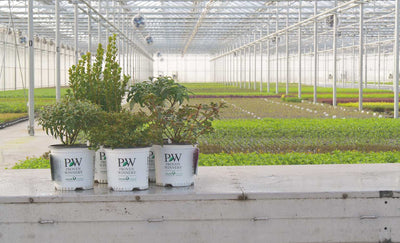
Hand-picked at our greenhouse
Shipped to your door
Arrives as young plant
Learn how to grow and care for hydrangeas like a pro! Discover different types of hydrangeas, when it's best to prune hydrangeas, how to change colored blooms, why they may be wilting, and everything else you need to know.
I got 4 plants. Two have died. Please replace them.
We're sorry you're having trouble with your plants. Our team of horticulture experts would love to take a closer look! Please contact us at customerservice@hydrangea.com with your order number and photos of the plants so we can better assist you. All orders are covered by our 60-day guarantee. We look forward to helping!
Fairly small and weak, damaged in shipping but starting to regrow. Holding out hope. Price is too high.
Hello! We’re sorry that you received plants that are not up to our standards. We try our best to provide excellent plants, but some factors, like shipping and handling, are outside our control. That’s why we have a 60-day guarantee on all of our orders. Please email your order number and pictures of your plants to start the claims process.
Unfortunately, it’s not always easy (or cheap) to grow great plants. Our prices reflect the quality and care we put into each plant, plus the availability of unique selections that can’t often be found in garden centers. To save on your order, watch for different sales and promos throughout the season. We look forward to helping!
LOVE these! A bit in the small side, but they'll grow. They arrived healthy and are flourishing. Can't wait to see them next year!!!
My hydrangea is tiny, but mighty. It's looking healthy and happy compared to the other one of the same variety that I bought from my local nursery. I will definitely purchase from here again if my garden has room.
Received late May/early June. Small plant, growing nicely. However the lower leaves have what look like rust spots. This has continued over many weeks and I have sprayed with Neem oil and a Bayer product for roses and plants. There has lately been new growth which has not yet developed those rust spots. Perhaps the problem has been remedied. Too soon to tell.