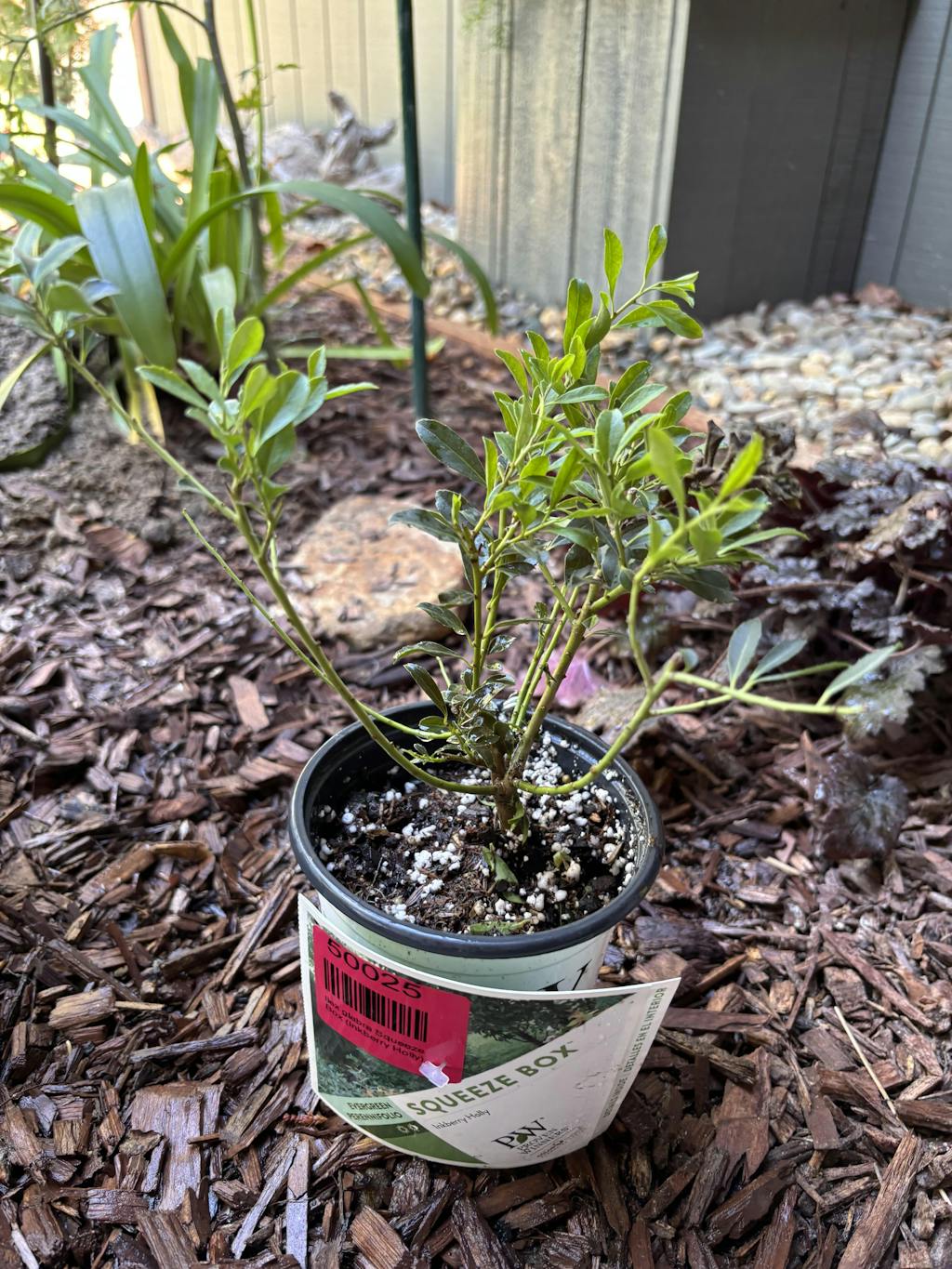
Squeeze Box® Inkberry Holly (Ilex)
Perennial
- Male pollinator, berry production when paired with Gem Box® inkberry holly & Strongbox® inkberry holly.
- Columnar evergreen, makes a shapely specimen.
- Native evergreen from Proven Winners looks like boxwood.
- Zones 5-9, sun/part sun, 4 – 6’ x 2 – 3’ at maturity.
 ZONE
ZONE
 EXPOSURE
 HEIGHT


Description
A native plant, Squeeze Box® inkberry holly from Proven Winners is indigenous to North America, naturally adapted to the climate and soil conditions of the region, they thrive without fertilizers or extra watering, once established. History buffs, take note: this plant is called "inkberry holly" because Civil War soldiers used its berries to make a crude ink to write letters home. They also act as natural pest controls, reducing the need for pesticides in the garden. Landscaping with native plants promotes biodiversity and provides shelter and quality food for wildlife and pollinators, bringing gardens to life.
Details
Patent: PP#35,019
Common name: Inkberry holly
Zone: 5-9
Sun exposure: Full sun (6+ hours sun) to part-sun (4-6 hours sun)
Height x width: 4 – 6’ x 2 – 3’
Foliage color: Green
Season of Interest: Year-round
Features: Space savers, rabbit resistant, Proven Winners, native, heat tolerant, evergreens, deer resistant, container plants, best for beginners
Uses: Hedge, low hedge, specimen, containers, formal gardens, native plant gardens.
How to Grow
Light: Full sun (6+ hrs/day) to part sun (4-6 hrs/day).
Water: Average to abundant (as long as soil is well-drained).
Space: 2-3' apart, depending on landscape role.
Fertilizing: If desired, fertilize in early spring, once the ground has thawed, with a granular rose fertilizer. A second application may be made in late spring/early summer as well.
Winterizing: 2-3" of shredded bark mulch is important to protect the shallow roots and minimize water loss. Do not allow plants to enter winter "thirsty"; dry soil during cold, windy weather is the main cause of leaf browning or even the plant dying.
Maintenance: Trim as needed to maintain shape and size desired. Save major pruning for mid-late spring, after new growth has emerged but before it becomes hard and woody.

Plant spacing is based on the ultimate width of the plants. This figure is normally given as a range; for example, 3-5’. If you live in a cold climate and/or want plants to fill in more quickly, plan to space at the shorter end of the range. If you live in a warm climate, are on a limited budget, or are willing to wait longer for plants to touch, use the higher end of the range. Using the larger number is recommended when calculating distance from a building or structure. There’s really no such thing as "maximum spacing": if you don’t want your plants to touch, you can space them as far apart as you’d like. All plant spacing is calculated on center, or in other words, the centers of the plants are spaced one half of their eventual width apart:

Unless you are planting in a straight line, as you might for hedges or edging, space your plants in a staggered or zig-zag pattern for a more interesting and naturalistic look:

Not sure just how many plants will fit in your garden? Our calculator gives you the exact amount of plants required for your space. Simply update the values and the calculator will re-calculate accordingly. Spacing information can be found in the 'How to Grow' tab on each plant's page.